


Are you ready to acquire a turnkey, authority-driven platform that can generate qualified personal injury leads from day one?

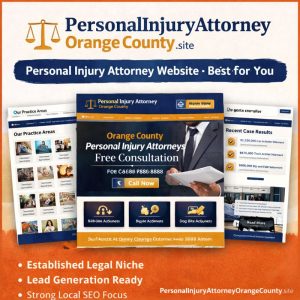
Authority-Driven Personal Injury Attorney Website For Sale
This listing presents a turnkey platform designed to help you attract high-intent clients and convert inquiries into cases. You will receive a polished, well-structured website designed to establish credibility, rank for core keywords, and grow your practice with minimal upfront setup.
What makes this website authoritative?
You gain a strong foundation built on established authority signals that search engines recognize and users trust. The site emphasizes credible attorney profiles, real client testimonials, transparent case results, and locally relevant content. It also uses schema markup, mobile-first design, and fast-loading pages to support a positive user experience.
- You benefit from a clear value proposition, consistent branding, and a professional online presence.
- You will see strong on-page optimization, authoritative internal linking, and an ethics-compliant lead capture system.
- You can leverage published, well-structured content to demonstrate expertise and reliability.
Core authority signals
To help you understand where the value comes from, here are the primary signals that contribute to authority:
- Attorney credibility: detailed bios, bar admissions, certifications, and notable verdicts or settlements.
- Local relevance: city and county targeting, practice area pages tailored to your region, and locally oriented testimonials.
- Content quality: comprehensive guides, FAQs, and evergreen resources that answer practical questions clients have.
- Trust indicators: client testimonials, case results (with appropriate anonymization), and transparent contact information.
- Technical authority: clean code, fast load times, secure connections (HTTPS), and accessible design.
Why this site is valuable for your practice
You’re investing in a digital asset that can start producing value immediately, with room for growth as you apply your own branding and market strategy. The site’s architecture supports scalable content expansion, easy optimization adjustments, and a smooth transition for you or your team.
- Lead generation effectiveness: strategically placed contact forms, strong CTA placement, and optimized phone and form interactions.
- Conversion-oriented design: readability, clear navigation, and a frictionless user journey from arrival to contact.
- Content leverage: existing blog posts and practice-area pages that can be updated to reflect shifting legal trends or local regulations.
- Brand continuity: a cohesive visual language that aligns with professional standards in personal injury law.
SEO performance and traffic overview
The site is built to capture highly relevant, local traffic with a focus on core practice areas. While performance varies by market and competition, you can expect a well-structured framework that supports sustainable growth.
- Target keywords: core phrases such as “personal injury attorney [city],” “car accident lawyer [city],” and other region-specific combinations.
- Content strategy: evergreen pages supported by a regular cadence of blog posts that address common consumer questions.
- Technical SEO: optimized meta data, semantic heading structure, and schema for attorney, organization, and reviews.
Table: Typical SEO-ready metrics you can expect from a well-optimized authority site in this niche (ranges will vary by market)
| Metric | Estimated Range | Notes |
|---|---|---|
| Monthly organic traffic (target market) | 1,500 – 3,500 | Depends on city density and competition; ongoing optimization can grow this. |
| Top ranking keywords | 20 – 60 | Core terms targeted by practice areas and local intent. |
| Domain Authority / Trust Flow | DA 25 – 40 | Reflects established content and backlink presence; improvements possible. |
| Conversion rate (form submissions) | 3% – 6% | With strong CTAs and optimized intake forms, you can approach this range. |
| Bounce rate (organic landing pages) | 40% – 60% | Improvements possible with page-level optimization and testing. |
Target audience and buyer profile
This site serves two primary audiences: potential clients seeking immediate legal assistance and other professionals or agencies looking to acquire a high-quality, lead-generating asset. Understanding these audiences helps you tailor your marketing and procedure for handling inquiries.
- Prospective clients seeking timely guidance after accidents or injuries.
- Local small-business marketers or law firm owners looking to expand through an established platform.
- Investors or agencies seeking a scalable digital asset with a clear lead-generation mechanism.
Ideal buyer profiles
| Buyer Type | Motivation | How this site supports your goals |
|---|---|---|
| Practicing attorney expanding to new markets | Quick expansion with a proven lead engine | Provides regionally targeted content and a ready-to-brand foundation |
| Marketing professional entering legal services | Steady pipeline of personal injury leads | Strong conversion framework, easy to optimize for new markets |
| Small agency owner | Add a scalable asset to your portfolio | Turnkey site with documented transfer process and support |
Site structure and content inventory
A solid site structure is essential for both user experience and SEO. The current architecture supports easy navigation, clear service delineation, and intuitive lead capture. You’ll find a balance between practical information for potential clients and authoritative signals that build trust.
- Home: Clear value proposition, visible contact options, and a concise overview of practice areas.
- About/Attorney profiles: Professional bios, credentials, and client-focused messaging.
- Practice areas: Dedicated pages for Car Accidents, Medical Malpractice, Wrongful Death, Slip and Fall, Workers’ Compensation, and Other Personal Injury categories.
- Blog: Educational content addressing common questions, legal processes, and local regulations.
- FAQs: Quick answers to typical client concerns to reduce friction.
- Testimonials: Client stories and outcomes (anonymized as appropriate) that demonstrate impact.
- Contact/Lead capture: Multiple channels including phone, form, and chat where available.
- Legal pages: Privacy Policy, Terms of Use, and compliance disclosures.
Content quality and optimization
The content is designed to inform, build authority, and convert, while remaining compliant with ethical advertising standards. Each page includes clear CTAs, structured data where appropriate, and internal linking to related topics. Blog posts cover evergreen topics and timely issues to keep your audience engaged and returning.
- Content depth: thorough explanations of the claims process, what clients should expect, and how compensation is determined.
- Content freshness: a plan for updating statutes, regulations, and case law to maintain relevance.
- Readability: accessible language with a logical flow, short paragraphs, and well-labeled sections.
- Internal linking: strategic cross-linking between practice areas and blog content to reinforce topical authority.
Technology and platform
This site is built on a modern, scalable platform designed for reliability, security, and ease of management. You’ll appreciate a clean backend, straightforward updates, and compatibility with common marketing tools.
- Platform: WordPress or a comparable content management system that supports simple content updates and plug-ins for SEO, forms, and analytics.
- Theme and design: responsive, mobile-friendly, and accessible with a professional, legal-appropriate aesthetic.
- Hosting and security: a reliable hosting environment with basic security measures, backup routines, and SSL.
- Plugins and integrations: essential SEO, analytics, forms, and performance optimization tools integrated into the workflow.
Design and user experience
Your users will benefit from a clean, professional, and intuitive design that aligns with client expectations in the personal injury space. The design emphasizes trust-building elements and makes it easy for visitors to contact you.
- Visual branding: consistent color palette, typography, and imagery that conveys credibility and empathy.
- Navigation: straightforward menus that guide visitors to the most important sections—areas of practice, success stories, and contact options.
- Accessibility: compliance with accessibility best practices to ensure all users can engage with your site.
- Speed and performance: optimized assets, caching strategies, and minimal server response times to reduce drop-offs.
Monetization model and revenue opportunities
This site is primarily a lead-generation asset designed to monetize inquiries through legal services. However, there are multiple pathways to maximize revenue and scale the business model.
- Lead-based client intake: convert inquiries into retained representation and client engagements.
- Local partnerships: create referral relationships with other professionals (medical providers, accident investigators) when compliant with ethical rules.
- Content-based monetization: if permitted by local regulations, monetize high-quality educational content or premium resources for clients.
- Advertising and sponsorships: limited, compliant advertising that does not detract from user experience or conflict with ethical advertising guidelines.
- Secondary markets: potential sale or licensing of the content and lead-generation framework to other practice areas or markets.
Revenue and cost snapshot
The current configuration emphasizes practical lead generation and clean handoffs to the attorney or firm owner. You can project returns based on your intake capacity, regional demand, and conversion rates. The following table presents a qualitative view rather than guaranteed numbers, reflecting typical ranges you might expect from a similar asset in this niche.
| Element | Description | Typical range or note |
|---|---|---|
| Lead value per client | Estimated revenue per client acquired through the site | Varies by case value and settlement range; often several thousand dollars per successful intake |
| Monthly lead volume (organic) | Organic inquiries generated per month | 20–120+ depending on market and optimization work |
| Conversion rate to retained clients | Percentage of inquiries that become clients | 10%–30% with solid intake and follow-up processes |
| Marketing costs | Ongoing costs for maintenance, hosting, and minor promotions | Typically 200–600 USD per month depending on tools used |
| Estimated annual revenue from leads | Projected revenue before marketing and overhead | Highly variable; use as a planning baseline rather than a guarantee |
Transferability and support
You gain a clear, documented process for transferring ownership and continuing operations without disruption. The seller provides a structured handoff, including account access, analytics data, content ownership, and recommended next steps for optimization.
- Domain and hosting: full ownership transfer instructions and access details.
- Analytics and search tools: ownership transfer for Google Analytics, Google Search Console, and any other analytics platforms.
- Content rights: confirmation of rights to publish, update, and syndicate content.
- Training and onboarding: a concise playbook that covers lead intake, content updates, and basic SEO adjustments.
- Ongoing support: an agreed-upon window of post-sale support to answer questions and assist with the transition.
Due diligence checklist
To complete your due diligence, review the following items. Having them verified helps protect you and ensures you understand what you’re purchasing.
| Item | What to verify | Why it matters |
|---|---|---|
| Domain ownership and transfer process | Confirm registrar details and ownership rights; verify you can transfer without restrictions | Ensures you can control the site after sale |
| Hosting access and terms | Verify hosting plan, renewal terms, and access credentials | Prevents future service interruptions |
| CMS admin credentials | Obtain admin-level access for updates and security management | Enables content updates and maintenance |
| Analytics accounts | Access to Google Analytics or other analytics tools; confirm data history and configuration | Helps you measure performance and set strategies |
| Search Console and SEO tools | Ownership and access to Search Console, GSC property verification, and any tools | Critical for ongoing SEO work and monitoring |
| Backlinks and domain history | Review backlink profile and any potential penalties | Aids in assessing long-term SEO health |
| Content license rights | Confirm you can publish, modify, and reuse content | Prevents copyright issues after transfer |
| Legal disclosures and advertising compliance | Verify compliance with local bar rules and advertising standards | Reduces risk of regulatory issues |
| Client data and intake forms | Ensure proper handling of any legacy client information and form data | Maintains privacy and continuity of service |
| Transfer of accounts and credentials | Collect all necessary login information for email, hosting, CMS, analytics, and other services | Essential for a smooth handoff |
| Support and transition terms | Document what support the seller will provide post-sale and for how long | Sets expectations for the transition |
Potential improvements and growth plan
Even as a ready-to-run asset, you have room to optimize and accelerate growth. A focused plan can help you unlock higher visibility, more inquiries, and better client conversions.
- Content expansion: publish new blog posts and resource pages on evolving legal issues, regional case trends, and practical advice for clients.
- Local SEO enhancements: deepen city-specific content, build local citations, and pursue neighborhood-focused content strategies.
- Conversion optimization: test new CTAs, forms, chat options, and testimonial formats to improve lead capture.
- Link-building strategy: develop relationships with reputable local outlets, bar association resources, and authoritative legal directories.
- Content upgrades: update existing practice-area pages with fresh data, updated statistics, and improved schema usage.
- Paid media alignment: if permitted, explore limited, compliant paid strategies to complement organic efforts and increase visibility.
Ideal first-step improvements
- Audit and refresh top-performing pages: ensure accuracy, update statistics, and optimize for user intent.
- Improve FAQ pages: expand questions to address common objections and concerns, increasing chance of capturing voice-search queries.
- Strengthen internal linking: ensure every practice-area page links to related resources and relevant blog posts.
- Enhance schema markup: verify that all pages use the appropriate FAQ, Article, and Organization schemas for better rich results.
Financial considerations and pricing
This section helps you evaluate the financial aspect of acquiring the website. You’ll consider the asking price, ongoing costs, and the potential return on investment based on your market, sales process, and resource allocation.
- Asking price: A fixed or negotiable amount reflecting the site’s authority, content quality, and lead-generation potential.
- Ongoing costs: hosting, maintenance, software licenses, and content updates.
- Potential ROI: estimated from lead value, conversion rate, and capacity to handle inquiries.
Table: Financial snapshot for planning (illustrative)
| Item | Details | Estimated range |
|---|---|---|
| Asking price | One-time payment for the asset | Negotiable; discuss with seller |
| Monthly recurring costs | Hosting, plugins, ongoing optimization | 200–600 USD |
| Estimated annual lead value | Revenue generated from retained clients | Highly variable; depends on conversion and market |
| Post-sale transition costs | Buyer’s cost to onboard and maintain the site | 0–1,000 USD (one-time) depending on needs |
Risk and compliance considerations
Operating a personal injury site involves regulatory and ethical considerations. You should be aware of what you can say in marketing, how you present outcomes, and how you handle client communications. Ethical advertising guidelines vary by jurisdiction, so you’ll want to ensure all content remains compliant as you take ownership.
- Advertising rules: ensure messaging is accurate, avoids guarantees, and clearly communicates the referral or representation nature of services.
- Client privacy: protect client information and comply with data protection requirements during intake and follow-up.
- Content accuracy: regularly review case results, statistics, and qualifications to avoid misrepresentation.
- Accessibility and inclusion: maintain accessibility standards to serve a wider audience and comply with legal requirements.
- Local variations: each market may have specific requirements; plan to adjust pages, testimonials, and calls to action accordingly.
Next steps and how to proceed
If you’re considering this authority-driven personal injury website for sale, you’ll want to complete a thorough evaluation before making an offer. The process typically includes a formal inquiry, a NDA, and a review of provided documents and data.
- Initiate discussion: reach out to request more details, the exact scope of access, and the transfer timeline.
- Perform due diligence: review domain, hosting, analytics, content rights, and the transfer process as outlined.
- Confirm transfer plan: agree on a timeline for ownership transfer, data migration, and post-sale support.
- Finalize agreement: sign a purchase agreement, complete payment, and execute the site handover with all credentials.
Quick checklist for your inquiry
- Clarify what is included in the sale (domain, hosting, content, analytics access, social media accounts, etc.).
- Request a recent performance snapshot (traffic, rankings, lead volume) and a sample of client intake forms.
- Confirm any ongoing commitments or obligations on the seller’s side post-sale.
- Ask about potential limitations on geographic targeting or brand usage after transfer.
- Establish a post-sale support plan and fees, if any, to ensure a smooth transition.
What you should do next
- Review the current site structure and content inventory to understand how it aligns with your practice areas.
- Assess the local market you intend to serve and how the site’s current optimization can be adapted to your city.
- Prepare your initial integration plan, including branding, messaging adjustments, and any immediate content updates.
- Plan a post-sale optimization roadmap that includes SEO improvements, content expansion, and conversion-rate optimization.
- Engage your legal and marketing advisors to ensure compliance with advertising rules and privacy requirements in your jurisdiction.
Final reflection: why this asset could be a strategic addition
You’re not just purchasing a website; you’re acquiring an authority-driven platform with a recognizable structure, credible content, and a proven approach to lead generation in the personal injury space. The asset is designed to stand up to scrutiny from both clients and search engines, and it provides a solid foundation for growth with your unique branding and market strategy.
- You’ll inherit a site that communicates professionalism and trust, which is essential in personal injury practice areas.
- You can build on a robust content framework that educates clients, answers their questions, and guides them toward contacting you.
- You gain a scalable asset that can be expanded into multiple markets or practice areas with a consistent, high-quality user experience.
If you’re ready to move forward, you can request a formal information package that includes the site’s traffic data, keyword rankings, backlink profile, and a transfer plan. You’ll then have the materials you need to perform a thorough evaluation and determine how this asset fits your growth goals and budget.
Would you like assistance drafting your inquiry or outlining a due diligence checklist tailored to your jurisdiction and target market? I can help you prepare a concise, professional set of questions and a plan to evaluate this opportunity effectively.







0 Comments