


? Are you skipping WordPress core updates and hoping nothing will go wrong?

The Hidden Risks Of Skipping WordPress Core Updates
You probably know that updates pop up on your dashboard, and they can feel like interruptions. It’s tempting to postpone them, especially when your site appears to be running fine. However, skipping WordPress core updates creates a cascade of hidden risks that can damage your traffic, reputation, and bottom line. This article explains those risks, shows why weekly checks matter, and gives practical steps you can take to keep your site safe and performing well.
What “core updates” actually mean
Core updates are changes to WordPress itself — the content management system that powers your site. They include security patches, bug fixes, performance improvements, and sometimes new features or architecture changes that affect how plugins and themes interact with the platform.
You should treat core updates as fundamental maintenance, not optional add-ons. They protect the framework your site relies on every time someone loads a page, fills out a form, or completes a purchase.
Why updates are released regularly
WordPress is open source and widely used. That makes it a frequent target for attackers and an active platform for developers who keep improving it. Updates are released to:
- Patch known vulnerabilities discovered by security researchers.
- Fix bugs that could cause data corruption or crashes.
- Improve performance and compatibility with modern web standards.
- Add or change APIs that plugins and themes rely on.
Keeping the core updated keeps your site aligned with the rest of the ecosystem and reduces the chance of unexpected failures.
Security risks: the most immediate threat
Security is the number one reason to apply core updates promptly. When vulnerabilities are discovered and patched, attackers often reverse-engineer the fix and scan the web for unpatched sites.
How attackers exploit outdated cores
Attackers use automated scanners that probe millions of sites for known vulnerabilities. If your site still runs a vulnerable version, a malicious script can:
- Gain administrative access.
- Inject spam or malicious redirects.
- Steal user data, including emails and payment details.
- Install persistent backdoors that survive a superficial cleanup.
You might not notice an attack right away, because compromises are often stealthy. Attackers seek to monetize access quietly, through spam, ad fraud, cryptomining, or selling access to other criminals.
Consequences of a breach
A breach can produce immediate and long-term consequences, such as:
- Loss of customer trust and reputational damage.
- Blacklisting by search engines and security services.
- Potential legal or compliance issues if user data is exposed.
- Revenue loss from downtime, cart abandonment, and mitigations.
Even after cleaning the infection, your site can carry lingering issues that make recovery costly and time-consuming.
Performance and stability problems
Beyond security, core updates often contain performance improvements and bug fixes that keep WordPress fast and stable.
How missing updates degrades performance
Older core versions can have inefficient database queries, memory leaks, or poor handling of modern PHP versions. These issues can cause:
- Slower page loads.
- Higher server load and hosting costs.
- Timeouts during traffic spikes.
- Compatibility problems with new versions of PHP and hosting environments.
Your visitors expect speed. When pages take longer to load, you lose conversions and search rank.
Unexpected crashes and fatal errors
As other parts of the web stack evolve — PHP versions, database updates, server software — incompatibilities become more likely if WordPress itself remains outdated. You can encounter white screens, fatal PHP errors, or complete site outages that are hard to diagnose without an update history.
Compatibility issues with plugins and themes
Plugins and themes rely on WordPress core APIs. When core changes introduce new behaviors or deprecate old functions, plugins and themes may stop working correctly — especially if they are not actively maintained.
Why you can’t assume plugins will fill the gap
Even if you update plugins and themes, they may still expect certain core behaviors. If your core is outdated, newer plugin versions might assume newer APIs and result in warnings or breakage. Conversely, if you update core but leave incompatible plugins in place, you risk runtime errors.
Cascading failures
A single incompatible plugin can break admin screens, block users from logging in, or interfere with checkout processes. These are not theoretical risks — they cause real revenue loss and require developer time to fix.
SEO and reputation damage
Search engines and security platforms take site security and performance into account. Skipping updates can lead to:
- Lower search rankings due to slow performance or mobile incompatibility.
- Warnings in search results and browsers (“This site may harm your computer”) if malware is detected.
- Loss of social sharing if link previews trigger security warnings.
Your audience may walk away permanently if they encounter warnings the first time they visit.
Hidden technical debt and future migration costs
When you delay updates, you accumulate technical debt. That debt makes future updates riskier and more expensive.
Why one missed update becomes many
Each skipped update widens the gap between your site and current standards. If you postpone several updates, upgrades become more complex because:
- API changes may require code refactoring.
- Plugins and themes may need rewrites or replacements.
- You may be forced into emergency migrations or paying for custom fixes.
What looked like a time-saver becomes a costly, disruptive overhaul later on.
Compliance and legal risks
Depending on your industry and the data you collect, you might be subject to regulations that require reasonable security measures. Failing to update core systems after known patches are released can be considered negligence in some contexts.
Data protection implications
If user data is exposed through a known vulnerability, you may face:
- Mandatory breach notifications.
- Fines or penalties under data protection rules.
- Civil liability if negligence is proven.
Keeping core updated is part of a defensible security posture.
The importance of weekly checks — why daily monitoring might not be necessary, but weekly is essential
Updates alone aren’t a complete strategy. Regular, weekly checks give you an opportunity to spot issues early, verify that updates were applied safely, and monitor site health.
What you catch with weekly checks
A weekly cadence lets you:
- Confirm that core, plugin, and theme updates have been applied.
- Verify backups completed successfully and test restore points.
- Check error logs, uptime, and performance metrics for anomalies.
- Scan for malware and suspicious file changes.
- Review security and SEO alerts from services like Google Search Console.
Weekly checks are a balance between responsiveness and operational bandwidth. They keep your site stable without overwhelming you with noise.
Why weekly checks are better than “set and forget”
Automatic updates can be useful, but they can also create silent breakages. Weekly manual or managed checks let you review changes, prioritize fixes, and coordinate rollbacks or staging tests when needed.
What a good update workflow looks like
You need a clear, repeatable process to minimize risk when applying updates. A good workflow includes staging, backups, testing, and monitoring.
Step-by-step update workflow
- Backup: Create a full site backup (files + database) before any changes.
- Staging: Apply updates on a staging environment that mirrors your live site.
- Testing: Run automated and manual tests, including login, forms, e-commerce checkout, and key pages.
- Apply updates to live: Schedule a maintenance window to apply changes to production.
- Verification: Run quick sanity checks and monitor logs and analytics.
- Rollback plan: Have a tested rollback procedure if something breaks.
- Documentation: Record what was updated, when, and any issues encountered.
This process reduces downtime and gives you confidence that changes won’t break customer-facing systems.
Tools that help
Use version control, automated tests, managed staging environments, and backup solutions that support quick restores. Many managed WordPress services include these features, which lowers the complexity barrier.
Weekly checks: a practical checklist
Use the table below as a weekly routine to keep your site healthy and secure.
| Task | Why it matters | Recommended action |
|---|---|---|
| Review pending updates (core, plugins, themes) | Prevent known vulnerabilities and compatibility issues | Check dashboard and update changelogs; schedule staging updates |
| Verify backups | Ensure you can restore after failures | Confirm successful backups and test restores monthly |
| Monitor uptime and performance | Detect outages or slowdowns early | Check uptime reports and page speed metrics |
| Scan for malware and file changes | Catch infections or unauthorized modifications | Run a malware scanner and review suspicious files |
| Check security logs and login attempts | Spot brute-force or unauthorized access attempts | Review login history and IP blocking rules |
| Test key user flows | Ensure revenue-critical functions work | Test contact forms, checkout, login, and search |
| Review analytics and search console | Identify drops that could indicate issues | Look for sudden traffic or indexation changes |
| Confirm HTTPS and certificate validity | Prevent browser security warnings | Verify certificate is valid and auto-renewing |
| Check plugin/theme developer updates | Ensure compatibility with core updates | Read changelogs and deprecation notices |
| Document changes and open issues | Keep team alignment and incident history | Log updates, issues found, and resolutions |
Following these weekly checks reduces the chance of surprises and keeps maintenance manageable.
How WordPress Care Essentials helps
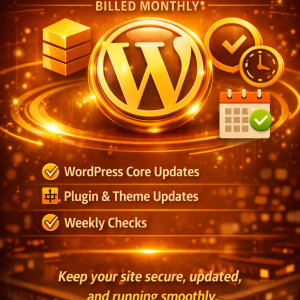
If maintaining this cadence feels like too much to manage, a managed maintenance package can handle it for you. WordPress Care Essentials typically includes:
- WordPress core updates: Applied safely and regularly to keep the platform patched.
- Plugin & theme updates: Managed to minimize compatibility issues and maintain functionality.
- Weekly checks: Routine verification of backups, uptime, performance, and security.
You’ll benefit from consistent maintenance without spending your own time on the details. Managed services also often include a staging environment, rollback capabilities, and expert monitoring.
Benefits of a managed package vs DIY
| Area | DIY approach | Managed package (WordPress Care Essentials) |
|---|---|---|
| Time investment | High — you must monitor and execute updates | Low — provider handles tasks and reporting |
| Risk of missed updates | Higher without automation and reminders | Lower because of scheduled maintenance |
| Backup & restore testing | Often overlooked or not tested | Regularly verified and tested by provider |
| Expertise for conflict resolution | Requires hired help or learning curve | Included as part of service |
| Documentation and audits | Manual and inconsistent | Centralized reports and logs |
| Cost predictability | Variable (emergency fixes can be costly) | Predictable monthly fee with included services |
If you value your time and want consistent protection, a managed package removes friction and lowers risk.
Common objections and why they don’t hold up
You may have reasons for postponing updates. Here are common objections and the counterpoints you should consider.
“My site has never been hacked, so it’s fine.”
Past immunity doesn’t guarantee future safety. Attackers exploit newly disclosed vulnerabilities quickly. One unpatched hole is all they need.
“Automatic updates can break things.”
Automatic updates are useful, but you should pair them with staging and weekly checks. Managed services combine automation with verification to reduce breakage.
“I don’t have the budget for a maintenance service.”
Upfront saving often leads to higher costs after an incident. Emergency cleanup, lost revenue, and reputation repair typically exceed the cost of regular maintenance.
“I run backups, so I can restore if something goes wrong.”
Backups are necessary, but restores are disruptive. You lose revenue during downtime and may still face data loss if backups are not current or tested. Weekly checks ensure backups are reliable.
Realistic scenarios that show the risk
You don’t need to imagine worst-case scenarios to see the problem. Here are plausible examples that many site owners face:
- An e-commerce store skips three core updates. After a plugin update, the checkout breaks, causing cart abandonment for days until a developer fixes the conflict.
- A small blog ignores a security patch. A botnet uses the vulnerability to inject spam links across pages, resulting in Google blacklisting the site for phishing behavior.
- A membership site postpones updates to avoid interruptions. Attackers gain access and exfiltrate user emails, triggering breach notification obligations and loss of trust.
Each scenario illustrates how a small skip becomes a bigger, costlier issue.
How to prioritize updates when resources are limited
If you must limit maintenance activity, focus on the most impactful items:
- Security patches for core and plugins — high priority.
- Backups and their verification — non-negotiable.
- Critical user flows (checkout, login, forms) — ensure these work after any change.
- Performance issues affecting conversions — fix as soon as practical.
You can also stagger updates: apply security updates immediately while scheduling less critical feature updates during low-traffic windows.
Best practices for safe updating
Use these proven practices to reduce risk when applying updates:
- Maintain a staging environment that mirrors production.
- Use incremental updates rather than bulk updating many things at once.
- Read changelogs and developer notes before large upgrades.
- Keep your PHP version modern and supported by your hosting provider.
- Use reputable plugins with active development and user reviews.
- Limit plugin count; remove unused or abandoned plugins.
- Keep an audit trail of all updates and maintenance activities.
These habits help you catch issues early and prevent surprises.
Emergency response plan: what to do if things go wrong
Even with precautions, things can break. Have an emergency plan:
- Restore from the most recent verified backup.
- Put the site into maintenance mode to reduce user impact.
- Revert the problematic update in staging and identify the conflict.
- Engage a developer or your maintenance provider for a permanent fix.
- Scan for any signs of compromise before re-opening the site.
- Communicate transparently with customers if data or service was affected.
A practiced emergency plan shortens downtime and limits damage.
Cost considerations: maintenance is an investment
You may view updates as a recurring expense, but they’re an investment in continuity. Consider the total cost of ownership:
- Regular maintenance cost (time, or service fees).
- Potential cost of a security incident (cleanup, fines, lost revenue).
- Hidden costs like SEO recovery and customer churn.
Compare predictable monthly maintenance to unpredictable emergency expenses — the math often favors routine updates.
Final action plan: what you should do this week
If you’re reading this because you want to act, here’s a concise plan:
- Check your WordPress version and update if a security patch is pending.
- Verify that you have recent, tested backups.
- Review pending plugin and theme updates and read their changelogs.
- Run or schedule a weekly check using the checklist table above.
- If you can’t commit the time or technical effort, sign up for a managed service like WordPress Care Essentials to handle core updates, plugin & theme updates, and weekly checks.
Taking these steps now prevents expensive problems later.
How WordPress Care Essentials fits into this plan
With WordPress Care Essentials, you get a maintenance partner that applies core updates safely, manages plugin and theme updates, and performs weekly checks that include backups, scanning, and verification. You’ll receive reports and have a rollback plan in place, which reduces your risk and frees you to focus on content and business.
Summary and final thoughts
Skipping WordPress core updates may feel like a shortcut, but it creates hidden risks across security, performance, compatibility, SEO, and compliance. Regular updates and weekly checks are practical, cost-effective ways to manage those risks and keep your site reliable. Whether you implement a disciplined in-house routine or use a managed package like WordPress Care Essentials, consistent maintenance protects your users, your revenue, and your reputation.
If you want, you can use the checklist and workflows outlined here to build a maintenance routine that fits your schedule, or consider an expert-managed solution so your site is always current and secure.







0 Comments