

Have you ever wondered what routine WordPress maintenance really means for your website?
In this guide, you’ll get a clear, practical picture of what maintenance entails, why updates are essential, and why weekly checks are a cornerstone of keeping your site fast, secure, and reliable. You’ll also learn how a structured maintenance plan—like WordPress Care Essentials—takes the guesswork out of keeping your site healthy so you can focus on growing your business.

What “Routine WordPress Maintenance” Really Means For Your Website
Routine WordPress maintenance is not a one-off task or a simple round of quick fixes. It’s a proactive, ongoing program designed to protect, optimize, and stabilize your site over time. Think of it as the equivalent of regular medicine and checkups for a digital asset that operates 24/7. When you commit to routine maintenance, you’re investing in fewer emergencies, better performance, and a more secure visitor experience.
This section breaks down the core idea: maintenance is a balanced blend of updates, checks, backups, and continuous improvement. By following a steady cadence, you reduce the risk of downtime, data loss, and vulnerability exploitation while ensuring compatibility with evolving web standards and technologies.
A practical definition you can act on
Maintenance is the deliberate, scheduled set of actions you perform to manage your WordPress site’s health. It includes:
- Keeping WordPress core up to date with the latest security and feature improvements.
- Applying updates to plugins and themes to fix bugs, patch security holes, and maintain functionality.
- Running regular checks to verify backups, performance, security, and content integrity.
- Monitoring uptime and error reports to catch issues before your users notice them.
- Testing changes in a safe environment before applying them to your live site.
When you view maintenance this way, you can design a repeatable process rather than chasing sporadic issues. Your goal is to minimize risk while maximizing performance and reliability.
The benefits you’ll notice
- Faster load times and a smoother user experience
- Fewer security incidents and quicker recovery if something goes wrong
- Better compatibility with new browsers, devices, and WordPress ecosystem updates
- More accurate analytics and reporting because you’re working with healthy data
- Less time wasted on firefighting and more time on growth activities
With that understanding in place, let’s dive into why updates matter and what keeps your site safe and efficient.
Why Updates Matter
Updates are the first line of defense against many common WordPress problems. They aren’t optional ornaments; they fix real issues that affect performance, security, and reliability. Here’s why you want to keep them current.
- Security patches close vulnerabilities. Attackers routinely scan for out-of-date WordPress cores, plugins, and themes. Each update is a potential shield against exploitation.
- Bug fixes improve stability. Updates address known issues that can crash pages, misbehave under certain conditions, or cause compatibility problems.
- Performance improvements are common. Updates often include code optimizations, faster loading patterns, or better caching compatibility.
- Feature improvements and compatibility. New functions and APIs help you take advantage of modern tooling and integrations while avoiding deprecated code paths.
- Compliance and compatibility with hosting and browsers. Updates help ensure your site behaves correctly across environments and adheres to evolving standards.
If you skip updates, you’re magnifying risk: a single vulnerability can lead to data loss, downtime, or blacklisting by search engines or security services. You also miss out on performance gains and new capabilities that can enhance your user experience and your own workflow.
To make the case concrete, consider this simple table that compares outcomes with and without updates.
Table: Updates—What changes when you stay current
| Component | What updates usually fix or improve | Why it matters to you |
|---|---|---|
| WordPress core | Security fixes, performance improvements, new features | Keeps site secure, fast, and feature-rich; reduces breakage risk with other components |
| Plugins | Bug fixes, security patches, compatibility adjustments | Prevents plugin conflicts, reduces crashes, maintains functionality across themes and PHP versions |
| Themes | Security patches, compatibility updates, design and UX improvements | Maintains visual consistency and user experience; prevents layout issues and compatibility problems |
| Translations (localization) | Language strings and message corrections | Ensures clear communication for visitors and reduces UI confusion |
| PHP and server compatibility | Better handling of modern server environments | Improves reliability and performance on current hosting stacks |
As you can see, updates touch security, performance, and usability. The goal is not to chase every new version but to maintain a stable, secure, and compatible platform for your content and visitors.
What Gets Updated and Why
Understanding what gets updated helps you plan and prioritize maintenance tasks. Not all updates affect every site in the same way, but the typical cycle includes core, plugins, themes, and occasionally translations or bespoke customizations.
- WordPress core updates: These bring security patches, performance improvements, and new features. They are essential for staying protected against known threats and ensuring WordPress remains compatible with modern hosting stacks and technologies.
- Plugin updates: Plugins extend functionality. Updates fix bugs, patch vulnerabilities, and address compatibility with new WordPress releases or PHP versions.
- Theme updates: Themes influence appearance and behavior. Updates can fix style glitches, improve accessibility, and ensure compatibility with updated WordPress versions.
- Translation updates: If your site serves a multilingual audience, translation updates correct wording and ensure consistent localization across the interface.
- Custom code adjustments: If you’ve added custom PHP code, you may need to adjust it to align with changes in WordPress core or plugins.
A practical way to think about updates is: you maintain the plumbing, wiring, and faucet of a house. When something needs a fix, you handle it promptly to prevent bigger problems down the line.
Table: Maintenance tasks and frequency
| Task | Frequency | Purpose | Who should perform |
|---|---|---|---|
| WordPress core updates | As released (usually monthly or as needed) | Security patches, stability improvements | Your maintenance provider or you, following a test in staging |
| Plugin updates | As released | Patch vulnerabilities, fix bugs, ensure compatibility | You or your provider with testing in staging |
| Theme updates | As released | Security fixes, compatibility, design adjustments | You or your provider with testing in staging |
| Backups | Daily or after major updates | Restore points, disaster recovery | Automated tool or service |
| Security scans | Weekly or daily (depending on risk) | Detect compromises, malware, or unauthorized access | Automated security service or plugin |
| Uptime and performance monitoring | Ongoing; weekly reviews | Detect downtime, slow pages, errors | Monitoring tool and human review |
If you want a reliable cadence, align updates with a tested process: update in a staging environment, verify key functionality, then deploy to production. This reduces the risk of a broken site affecting your visitors.
The WordPress Care Essentials Package
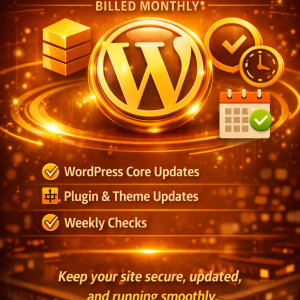
Your maintenance program can be simple or comprehensive. WordPress Care Essentials is designed to cover the core areas that keep a site healthy: WordPress core updates, plugin and theme updates, and weekly checks. This combination addresses the most critical risk factors—security, compatibility, and reliability—without turning maintenance into a full-time job for you.
Key components of WordPress Care Essentials:
- WordPress core updates: Regular application of the latest core changes for security and performance
- Plugin updates: Timely patches and compatibility fixes to preserve functionality
- Theme updates: Security and UX improvements to prevent visual and functional issues
- Weekly checks: A consistent, repeatable set of verifications to catch problems early and confirm backups, performance, and security
Why weekly checks matter
Weekly checks create a predictable rhythm that catches problems before they escalate. Here’s why they are important:
- Early detection: You’ll spot broken links, 404 errors, or failed backups before your visitors do.
- Consistency: A weekly cadence reduces the chance of drift between your live site and the plans you have in place.
- Security hygiene: Regular scans increase the likelihood of catching suspicious activity or outdated components promptly.
- Performance visibility: You’ll notice performance regressions quickly and have evidence to guide optimizations.
- Documentation: Regular checks build a history you can reference to understand trends and justify maintenance decisions.
Table: Weekly checks checklist
| Area | What to check | Why it matters | How to verify |
|---|---|---|---|
| Backups | Ensure latest backup exists and can be restored | Data safety; disaster recovery | Run a restore test in staging or verify backup integrity report |
| Security | Scan for malware, unusual access, and compromised accounts | Protect visitors and reputation | Review security dashboard and logs |
| Uptime | Check site availability and incident reports | Visibility into downtime | Use uptime monitor; review incident history |
| Performance | Page load times, caching behavior, third-party requests | User experience and SEO | Run speed tests; review waterfall diagrams |
| Broken links | Check for 404s and redirects | Content quality and SEO | Run a link checker; fix or set redirects |
| Forms and conversions | Test contact forms, newsletter signups, checkout flows | Conversions and user experience | Submit test entries; verify data capture |
| Content integrity | Verify that recent posts and pages render correctly | Accuracy and branding | Open sample pages; check for layout issues |
| Updates status | Confirm all components are up to date | Security and stability | Review update history and changelogs |
As you can see, weekly checks act as a health screen for your site. They’re not just about catching problems; they’re about confirming everything is aligned with your goals and standards.
Why Weekly Checks Are Necessary for Smooth Operation
A weekly checks routine doesn’t replace real-time monitoring, but it provides a structured opportunity to review your site’s health from a higher level. Here are some concrete reasons you’ll benefit from weekly checks:
- Consistent oversight reduces the number of emergencies you face. When you have a predictable checklist, you catch issues before they disrupt visitors or revenue.
- You gain better visibility into your site’s evolution. The weekly cadence builds a historical record of performance, security, and content quality.
- Your team (whether you’re solo or part of a larger organization) can coordinate more effectively. A shared rhythm ensures everyone knows what to look for and when to act.
In practice, weekly checks serve as a “quality control” step for your online presence. They help you stay on top of growth, ensure trust with your audience, and keep your site aligned with best practices.
How Weekly Checks Fit into a Maintenance Plan
To make weekly checks practical, you can embed them into a broader maintenance workflow. Here’s a typical flow you can adapt:
- Monday: Run automated checks (backups, security scans, uptime). Review results and flag any anomalies.
- Tuesday–Thursday: Apply updates in a staging environment, test core functions, forms, and key workflows.
- Friday: Deploy verified updates to production, perform a quick health check, confirm backups are intact.
- Saturday–Sunday: Run lighter verifications, monitor for any new issues, and prepare for the upcoming week.
This schedule keeps you from feeling overwhelmed, ensures you have time to test changes, and minimizes the chance of updates breaking live functionality. If you run a high-traffic site or handle sensitive data, you may want to adjust the cadence to be more frequent or add more automated checks.
The Value of a Consistent Maintenance Routine
A steady maintenance routine yields a clear return on investment. Not only do you mitigate risk, but you also improve user trust, search engine performance, and long-term site health. Here are some specific benefits you can expect:
- Reduced downtime: Fewer outages because you detect and address issues early.
- Fewer security incidents: Regular patches and scans lower the risk of breaches and malware infections.
- More stable user experience: Consistent performance reduces bounce rates and increases engagement.
- Easier upgrades: When you update regularly, major version changes are less risky and can be applied with confidence.
- Predictable budgeting: A regular maintenance plan helps you allocate resources and plan for upgrades.
Table: Cost and ROI of maintenance
| Scenario | Cost (rough estimate) | Benefit | ROI considerations |
|---|---|---|---|
| Minimal maintenance (occasional patches) | Low upfront; potential high cost if emergencies occur | Occasional fixes | High risk of outages; unpredictable costs |
| Regular maintenance (care essentials) | Moderate cost; predictable monthly/quarterly | Steady performance, better security, fewer surprises | Higher uptime, improved user experience, better SEO signals |
| Comprehensive, proactive maintenance | Higher cost; includes staging, testing, automation | Best reliability and future-proofing | Best long-term ROI if uptime is critical (e-commerce, high traffic) |
If you’re weighing options, think about your site’s priorities: uptime, security, and user experience are often the top three. Routine maintenance is a lever you can pull to improve all three simultaneously.
Implementing a Practical Maintenance Plan
Setting up a maintenance plan that you can actually follow is essential. Here are practical steps you can take to implement routine WordPress maintenance without overcomplicating your workflow.
- Define a cadence that fits your site. A baseline of weekly checks and monthly core/plugin/theme updates works for many sites. If you have higher risk, consider more frequent checks or additional automation.
- Establish a staging environment. Test updates and changes in staging before applying them to production to minimize live-site risk.
- Automate where possible. Use automated backups, monitoring, and alerting to reduce manual overhead. automation is not a substitute for human review; it complements your process.
- Create clear runbooks. Document the steps you take for each maintenance activity, including what you test, how you test, and what signals indicate success or failure.
- Maintain a rollback plan. Always have a way to revert updates if something breaks, and verify your backups regularly.
- Review and adjust. Periodically reassess your maintenance plan. Update your checklist, cadence, and tools as your site evolves.
If you’re working with a team or a service provider, ensure roles and responsibilities are clearly defined. A small mismatch can lead to missed updates or unclear ownership of incidents.
Tools and Resources You Might Use
To support your maintenance plan, you can leverage several tools and practices. Here are some common options that work well for many WordPress sites:
- Backups: Automated backups that run daily and retain several Restore points; test restores regularly.
- Monitoring: Uptime and performance monitoring to catch issues quickly.
- Security: Malware scanning and login protection to detect unauthorized access.
- Staging: A staging environment for testing updates, theme changes, or plugins before pushing to production.
- Automation: Scripting and automation for repetitive tasks (like patching or status reporting) to save time.
Here are a few practical capabilities you might adopt:
- Automated daily backups with one-click restores.
- A staging site used specifically for testing updates and new features.
- A weekly health report that highlights changes, performance metrics, and any issues found.
Using these tools consistently helps you maintain quality without burning out.
Common Misconceptions About WordPress Maintenance
You might hear a few myths when people discuss WordPress maintenance. Here are some common misconceptions, along with the truth, so you can make informed decisions.
- Myth: Maintenance is only about updating plugins and themes. Reality: Updates are essential, but maintenance also includes backups, security checks, performance tuning, and testing changes in a staging environment.
- Myth: You don’t need a staging site for small sites. Reality: Even small sites can break with updates if you skip testing. A staging environment reduces risk and protects your live site.
- Myth: Backups are optional or only for emergencies. Reality: Regular backups are your safety net. They allow you to recover quickly from data loss, corruption, or ransomware incidents.
- Myth: Security is someone else’s problem. Reality: Security is everyone’s responsibility. Regular scans, updates, and access controls help keep your site safer.
By understanding the truth behind these myths, you can implement maintenance with confidence and avoid common traps.
A Step-by-Step Example: Getting Started Today
If you’re ready to start a routine maintenance practice, here’s a concrete, actionable sequence you can follow in the next few weeks.
- Inventory your site. List the core, plugins, and themes you’re using, along with their current versions. Identify any that are end-of-life or no longer supported.
- Set a baseline. Create a monthly maintenance plan that includes core/theme/plugin updates, weekly checks, and backups.
- Establish a staging workflow. Create a staging environment if you don’t have one. Test updates and changes there first.
- Implement automation. Set up automatic backups, security scans, and uptime monitoring. Create alerts to notify you of anomalies.
- Build your runbooks. Document the exact steps you take during each maintenance activity, including how you verify success.
- Review and refine. After each cycle, review results, adjust the plan, and optimize for your site’s unique needs.
Through these steps, you’ll establish a sustainable routine that minimizes risk and keeps your site healthy over time.
Why This Matters for Your Website’s Long-Term Health
Routine maintenance is not merely a precaution; it’s a strategic investment in your online presence. When you commit to regular updates and weekly checks, you’re setting up your site to:
- Serve visitors reliably with minimal downtime
- Protect sensitive data and maintain trust with users
- Remain compatible with evolving technologies and hosting environments
- Preserve the value of your site by preventing costly, disruptive issues
If you think about your site as a digital asset with a long horizon, the logic of routine maintenance becomes obvious. You’re not spending money on arbitrary chores; you’re protecting a platform that supports your content, services, or products.
Final Thoughts
What you do today with updates and weekly checks shapes how your site performs tomorrow. The WordPress Care Essentials package—centered on core updates, plugin and theme updates, and weekly checks—offers a practical, effective framework for maintaining health, security, and performance. By understanding the role of updates, embracing a weekly health check routine, and using a staging environment and automation where appropriate, you’ll reduce risk, improve reliability, and create a better experience for your visitors.
If you’d like, you can start with a small, manageable maintenance plan and scale up as your site grows. The most important step is to commit to a regular cadence and treat maintenance as an investment in your site’s future rather than a one-off task.
Would you like to see a customized maintenance plan tailored to your site’s current setup and traffic level? I can help you map out the exact steps, frequencies, and checks to fit your needs and budget.









0 Comments